
Thermal insulation in rural houses

At Torregra we carry out blown thermal insulation in rural houses, farmhouses and village houses throughout Catalonia, studying each home to determine which areas and solutions are most suitable.

Request a technical visit
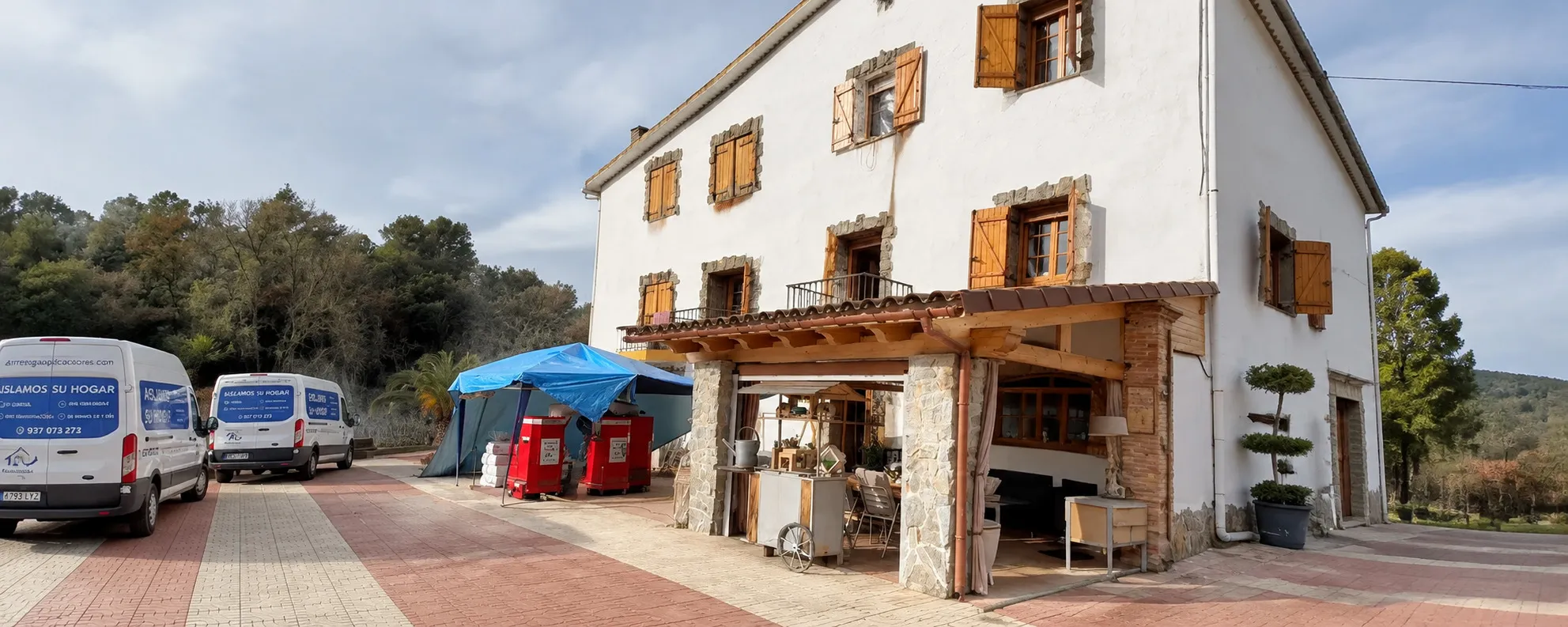
Thermal insulation in rural houses

Rural houses in Catalonia: very different buildings that require diagnosis

Catalan rural architecture encompasses a wide variety of buildings: farmhouses, tenements, village houses, and buildings renovated at different times. Stone or earthen walls provide mass and thermal inertia, but their performance is not equivalent to that of an insulating layer and depends on their composition, thickness, and condition.

It's also common to find roofs, extensions, or false ceilings constructed using different methods than those of the original building. Therefore, it's not advisable to assume beforehand which parts of a rural house need or can be insulated.

01.

2.773

Rural tourism establishments in Catalonia in 2025.

02.

902

Establishments in the province of Girona, which has the highest concentration.

03.

4 modalities

Masía, masovería, casa de pueblo compartida y casa de pueblo independiente.

04.

Various buildings

Stone, earth, ceramic factory and renovations can coexist in the same building.

*Source: Idescat, Statistical Yearbook of Catalonia, Rural Tourism 2025.

Thermal insulation in rural houses

Which areas of a rural house can accommodate blown-in insulation?

Blown-in insulation requires a suitable cavity or building space in which to introduce the material.

In a farmhouse or village house, some areas may be suitable while others are not, even within the same building. That's why we check every element before proposing any work.

Element Can it be inflated? What we check / possible action
Casing or suspended ceiling Yes, if the space is accessible and suitable. We’ll check the cavity and access. If it’s feasible, we can fill it without removing the entire ceiling.
Uninhabitable attic or loft It depends on the configuration. We can work on the floor slab or in existing spaces when the system and access allow it.
Extensions and renovations with double-leaf glazing Yes, if a suitable cavity exists. We inspect the building envelope and check the continuity, thickness, and condition of the cavity.
Walls or party walls with a cavity Yes, if the cavity is adequate. We assess whether blown-in insulation can improve thermal performance and, depending on the overall structure, acoustic performance as well.
Solid stone wall, rammed earth, or other masonry without an air gap. Not suitable for injection into the wall itself. If there is no air gap, injection is not possible. We will study other areas of the building envelope that can be improved.

Thermal insulation in rural houses

How we choose the insulation solution in an old house

In traditional buildings, it is not advisable to choose the material solely based on one isolated characteristic.

It's essential to consider the construction of each building envelope, its condition, the presence of moisture, the available air gap, and the performance requirements of the home. Compatibility with the existing structure is just as important as thermal efficiency.

Criteria What we review Why it matters
Compatibility with the enclosure Existing materials, cavity, thickness, obstacles, and condition of the building. A farmhouse can combine traditional walls and renovated sections with very different behaviors.
Humidity and hygrothermal behavior If there is dampness, condensation, or a risk of water ingress, check before insulating. Insulation should not be used to conceal a problem that requires other treatment.
Thermal performance Conductivity, available thickness, and continuity of the solution. Determines the improvement that can be achieved in the actually treated area.
Additional features Fire resistance, acoustic performance, material origin, and project requirements. This allows us to choose between mineral wool, rock wool, cellulose, cork, or other solutions suited to the specific needs.

Thermal insulation in rural houses

Rural houses for rent and rural houses to live in

Not all rural houses have the same use or require the same planning. We adapt the intervention according to the type of accommodation, the occupancy of the house, and the areas where insulation is technically feasible.

01.

Rural accommodations

We coordinate the work according to reservations, season and availability.

02.

inhabited farmhouses

We organized the intervention by zones to reduce discomfort in daily life.

03.

Townhouses

We study walls, chambers and roofs according to the configuration of the property.

04.

Adapted intervention

We only work on enclosures and spaces where the system is viable.

Aislamiento térmico en rural houses

How we work in rural houses

We travel to rural houses and traditional homes throughout Catalonia, including mountain areas and inland regions.

The feasibility of each action depends on the construction and access, not the location of the property.

01. Technical study

We checked the roof, attic, walls and chambers to find out which areas can be intervened.

02. Proposal

We define which parts should be isolated, with what solution, and what scope the work will have.

03. Execution

We access the chambers or spaces planned with the necessary intervention for each area.

04. Sealing and inspection

We closed the access points and reviewed the finishes, taking care to respect the existing character.

Thermal insulation in rural houses

Benefits of thermal insulation in rural houses

Improving the thermal insulation of a rural house helps maintain a more comfortable temperature throughout the year, improve the building's energy efficiency, and offer a more pleasant stay for guests.

Thermal insulation in rural houses

Why Torregra for your rural house?

Each rural house has its own unique construction characteristics, especially when it comes to older buildings or those with different types of enclosures. That’s why we analyze each case before defining the work and propose the most suitable solution based on the property’s condition.

  • We tell you which areas can be insulated and which require another solution.
  • Preliminary technical study to avoid blindly intervening in buildings with different construction systems.
  • Experience also in diagnosing dampness when the home presents stains, condensation or capillary action.
  • Own team based in Viladecans and service throughout Catalonia.

Frequently Asked Questions

Is it possible to insulate a stone house without construction work?

It depends on the construction. A solid wall without an air gap cannot accommodate blown-in insulation, but the same house may have roofs, false ceilings, extensions, or enclosures with suitable spaces. We check this before providing a quote.

Stone walls provide mass and thermal inertia, which helps to dampen temperature fluctuations, but this doesn't necessarily mean they have high thermal resistance. Furthermore, the roof, openings, and air infiltration also influence the comfort of the home.

It can be done without dismantling the entire roof when there is an attic, false ceiling, loft, or other accessible and suitable space. The access method depends on the building's structure, so we check it during the site visit.

In tourist accommodations, it's often helpful to schedule work during the off-season or between bookings. The duration depends on the areas to be treated, access points, and the building's layout.

Not necessarily. If there is capillary action, seepage, or another problem, the underlying cause must be addressed. Improving insulation can help with certain types of condensation associated with cold surfaces, but only when the diagnosis confirms that cause.

Do you want to know which parts of your country house can be insulated?

We inspected the roof, attic, and walls to determine which areas could be insulated with blown-in insulation and which parts required a different approach before preparing the budget.